Two-part jewelry epoxy
Consider it when a compatible two-part system suits both substrates and you can mix, position, stabilize, and cure the joint as specified.
Key check: mixing and cure requirements must fit the assembly process.
For sea glass jewelry, choose an adhesive by the joint rather than by a generic “strongest glue” claim. First verify that the specific product is intended for glass and the actual finding material, then match it to contact area and bond geometry, bond-line visibility, working and cure conditions, and expected wear. If a UV-curing adhesive requires light that the assembled joint blocks, choose a compatible cure method that does not depend on that light access.
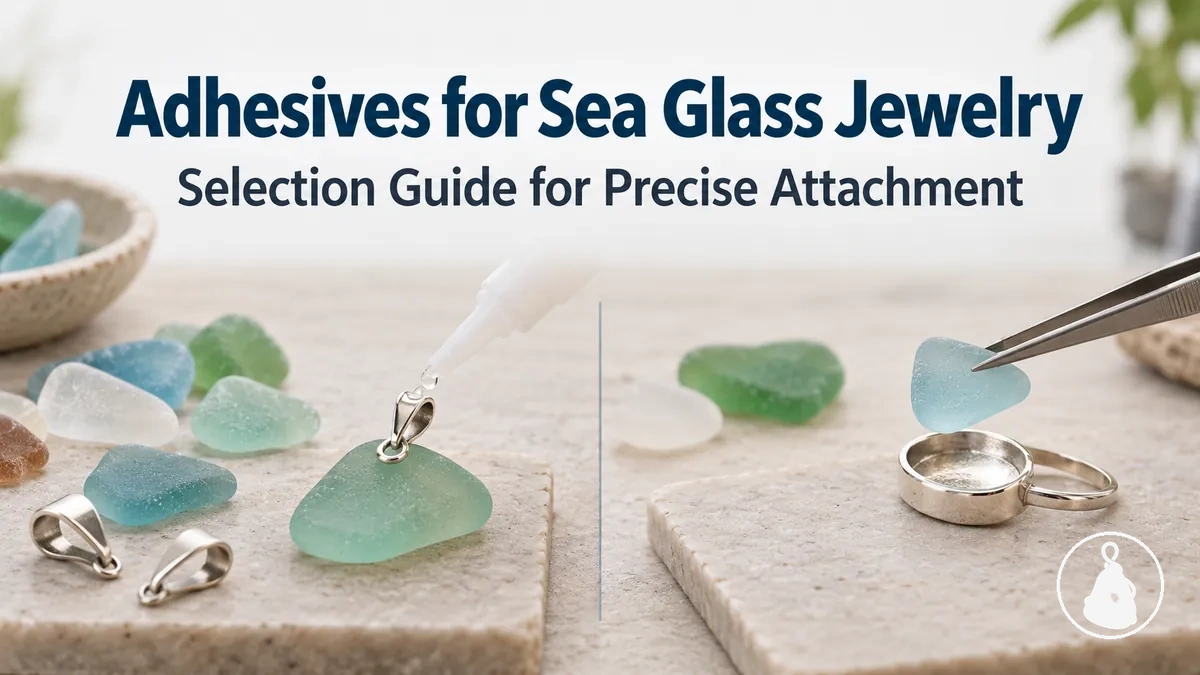
Choose the adhesive profile from the joint conditions
Use these three gates in order. A category is only a candidate after the selected product meets the material and cure requirements of the actual sea-glass-to-finding joint.
Two-part jewelry epoxy
Consider it when a compatible two-part system suits both substrates and you can mix, position, stabilize, and cure the joint as specified.
Key check: mixing and cure requirements must fit the assembly process.
Clear glass or jewelry adhesive
Consider it when a compatible single-adhesive application suits the joint and its cured appearance and cure behavior fit the design.
Key check: “clear” describes cured appearance, not an invisible bond.
UV-curing glass adhesive
Consider it only when the selected product is compatible with the substrates and its required curing light can reach the adhesive in the assembled joint.
Key check: an opaque or shielding finding can make the required light access impossible.
No category is a universal winner. Product-specific compatibility, preparation, cure instructions, and the actual bond geometry still control suitability.
Adhesive attachment depends on the bond between the sea glass and finding; mechanical attachment is a separate retention path when the design should not rely on an adhesive joint.
Adhesive attachment is most suitable when the finding provides a usable, well-aligned contact area and the chosen adhesive is compatible with both substrates and the expected conditions of wear.

During wear, the joint can be exposed to pulling, peeling, movement, moisture, and repeated handling. There is no universal load or service-life value for every sea-glass bond because durability depends on the substrates, bonded area, preparation, cure, geometry, and actual use.
The main adhesive types used for sea glass jewelry are two-part jewelry epoxy, clear glass or jewelry adhesive, and UV-curing glass adhesive where its curing conditions suit the joint.
Jewelry epoxy combines separate components before application, while clear jewelry adhesive is applied as a single adhesive and UV-curing adhesive requires suitable light access for cure.
Products within each category can differ, so category choice depends on the sea glass and metal finding substrates, desired cured appearance, and cure behavior.
Adhesive types used for sea glass jewelry differ in substrate fit, cured appearance, working and cure behavior, and practical limitations.
The table compares these categories without ranking individual products.
| Adhesive category | Typical jewelry bond | Cured appearance | Working and cure behavior | Key limitation |
|---|---|---|---|---|
| Two-part jewelry epoxy | Sea glass bonded to a compatible metal finding | Appearance is formulation-specific and must be checked for the selected epoxy | Separate components are mixed before application, then the bond cures under the selected product's stated conditions | Mixing and cure requirements must suit the joint and application process |
| Clear glass or jewelry adhesive | Sea glass bonded to a compatible jewelry finding | A clear formulation can suit a visible bond line, while final residue and appearance remain product-specific | Applied as a single adhesive; working behavior and cure conditions are product-specific | Substrate compatibility, cured appearance, and cure conditions must match the intended joint |
| UV-curing glass adhesive | Glass-to-finding joints where the adhesive can receive the required curing light | Clear formulations can suit visible joints, with final appearance determined by the selected product and bond line | Cure requires the adhesive joint to receive the light conditions specified for the selected product | Joint geometry that blocks the required curing light can prevent the intended cure conditions from being met |
Jewelry epoxy is distinguished by its two-part preparation, while clear jewelry adhesive uses a single-adhesive application and shifts attention to product-specific substrate compatibility, residue, and cure conditions.
A glass adhesive should be checked for the actual sea-glass-to-metal-finding combination rather than assumed suitable from the category name alone.
UV-curing adhesive adds a different condition: the adhesive within the joint must receive the curing light required by the selected product.
Matching the cure method to the joint is therefore part of choosing between these adhesive categories.
Adhesive types used for sea glass jewelry also differ visibly in preparation and cure mode: two-part epoxy requires mixing, clear jewelry adhesive uses a single application, and UV-curing adhesive requires curing-light access at the joint.
The image shows these three category-level differences with sea glass and metal findings.
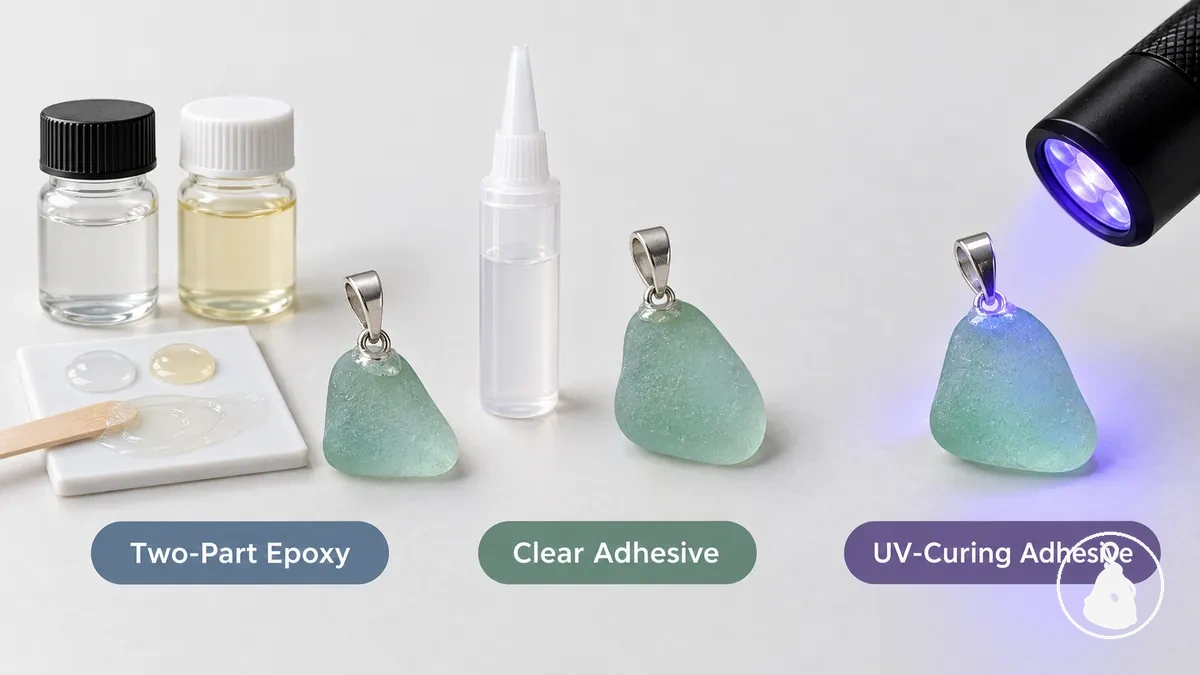
For example, a glue-on metal finding that blocks the curing light required by a UV-curing adhesive does not provide the same cure access as a joint where that light can reach the adhesive, so a compatible category with a different cure method may fit that geometry better.
A two-part jewelry epoxy introduces mixing before bonding, while a compatible clear jewelry adhesive provides a single-adhesive application when its substrate and cure requirements match the design.
These adhesive choices remain one part of the wider sea glass jewelry materials needed for the finished piece.
Selection criteria for sea glass jewelry adhesives start with substrate compatibility and bond requirements before preference-based features such as cured appearance or application convenience.
The adhesive must be intended for the sea glass and finding material, while the joint must provide usable contact area and geometry for that bond system.
Working time, cure conditions, application control, and expected wear then determine whether the adhesive can be applied and cured under the conditions required for that joint.
The checklist organizes these required conditions before preference-based trade-offs are considered.
Selection criteria for sea glass jewelry adhesives work together around the same sea-glass-to-finding joint.
The image organizes the main bond conditions visually, including material fit, contact area, bond-line visibility, positioning, and cure control.

The same adhesive can suit one design and fail another because joint conditions change: contact area, bond-line visibility, cure access, and positioning can turn the same product from a plausible fit into a poor fit.
An advertised strength figure does not by itself establish finished-jewelry durability because the assembled joint, not the adhesive label alone, carries the load.
Bond strength and durability must therefore be considered with joint geometry and movement; the image shows how broad supported contact and a small leveraged contact place different mechanical demands on the bond.
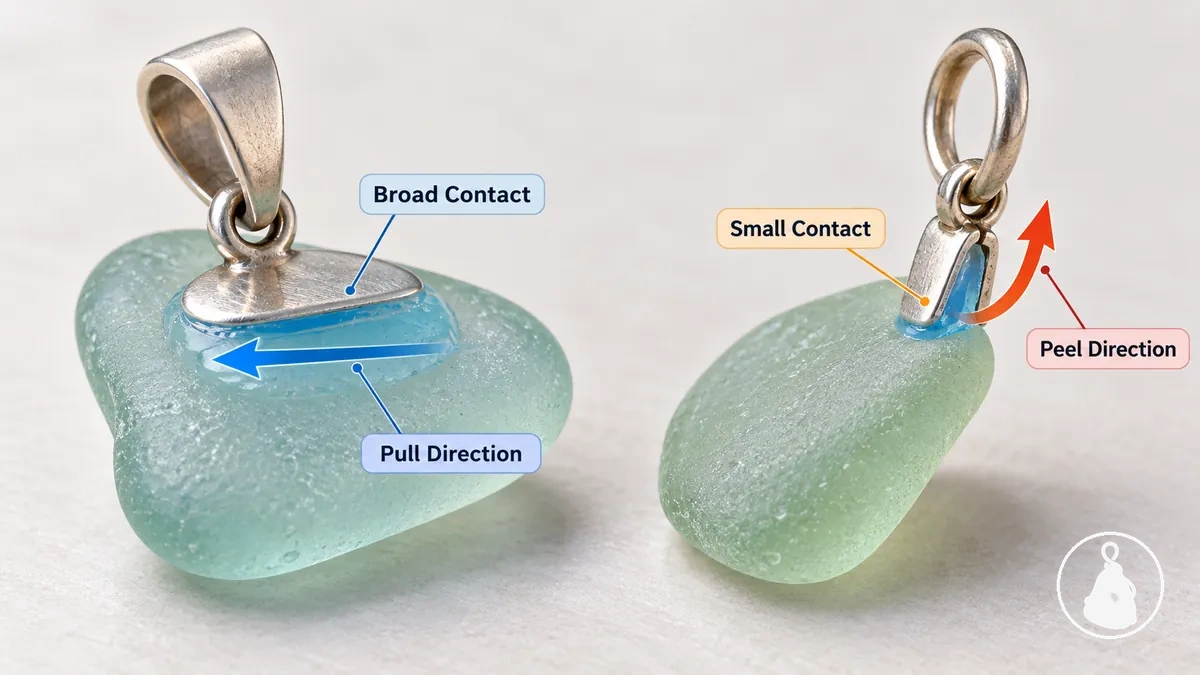
A broad, supported contact can spread an applied load across more bonded area, while a small or leveraged contact can direct more of the demand toward an edge and increase the tendency for peel.
Movement before the required cure state can allow slippage or disturb positioning, while movement, moisture exposure, and handling during use become service conditions that the cured adhesive joint must tolerate.
Cured clarity describes the appearance of the cured adhesive through or around the sea glass; it does not mean the bond line will be visually undetectable.
A cleaner-looking joint
Uses controlled adhesive placement, keeps squeeze-out within the intended contact area, and places visible bond lines where the design can tolerate them.
What can still remain visible
Bond lines, haze, squeeze-out, or residue can remain noticeable on transparent or translucent sea glass even when the adhesive is described as clear.
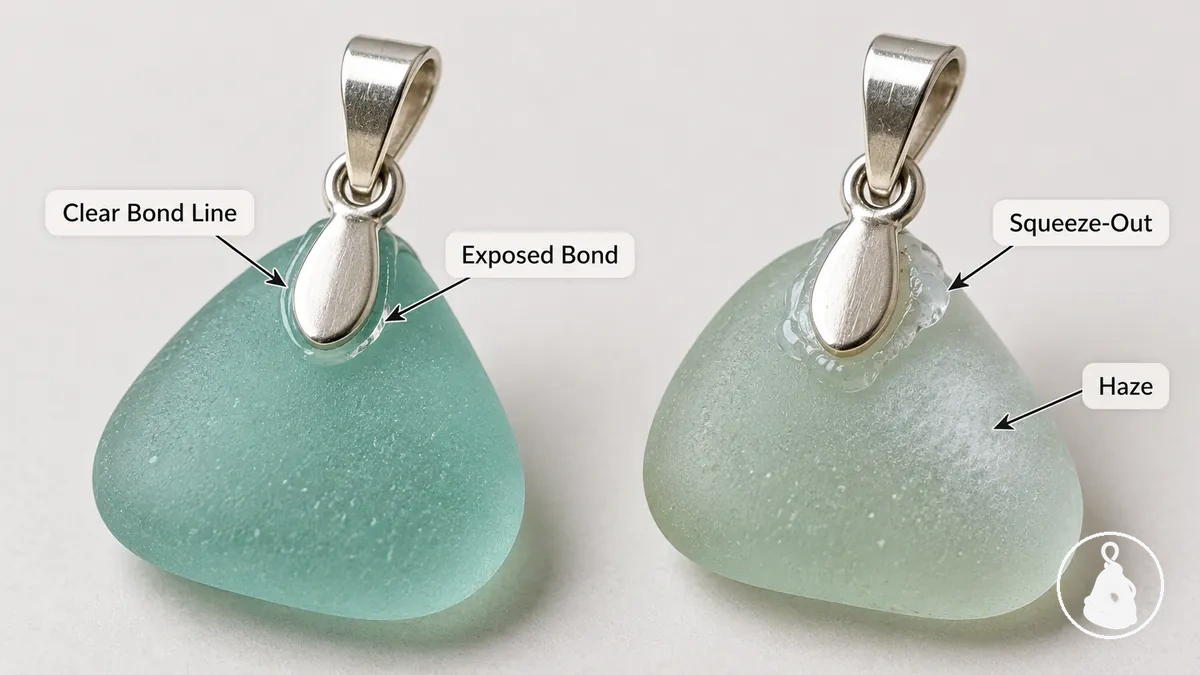
A bond area hidden behind a finding can make the cured adhesive less noticeable, while an exposed bond area makes application control and cured appearance more important to the finished look.
Three timing stages to keep separate
These stages are not interchangeable, and their durations are product- and condition-specific rather than universal for sea-glass jewelry.
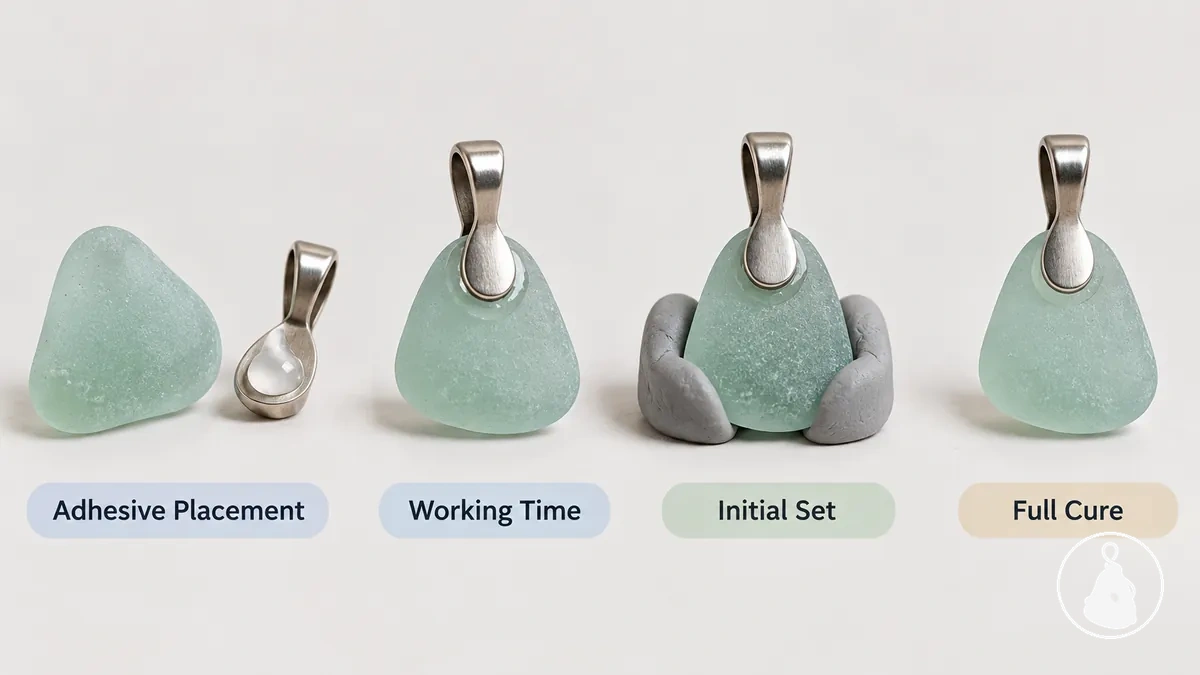
Viscosity and dispensing control affect placement and squeeze-out, while the available working time must allow accurate alignment before the joint needs stabilization. A shorter cure is not automatically better if the application window or handling behavior does not suit the assembly.
Compatibility is determined by the actual sea-glass-and-finding joint rather than by the material label alone.
For a glass-to-metal or glass-to-glass bond, the selected adhesive's stated substrate compatibility must cover the specific material pairing, and its cure requirements must be achievable at that joint.
Matching adhesive to sea glass, findings, and bond area therefore means evaluating the surface condition, bond geometry, usable contact area, and cure requirements together.
The table organizes jewelry-relevant material pairs and joint conditions by the factors that can make an adhesive suitable or create compatibility risk.
| Bond pairing | Surface or joint condition | Relevant adhesive requirement | Decision caution |
|---|---|---|---|
| Sea glass to metal finding | Glass-to-metal contact with a broad, closely fitting bond area | Stated substrate compatibility with glass and the specific jewelry finding material, with cure conditions that can be met across the joint | A material match alone is insufficient when surface condition, poor alignment, or joint geometry prevents the adhesive's stated application or cure conditions from being met |
| Sea glass to metal finding | Small, curved, or partly exposed glass-to-metal contact area | Compatibility with both substrates plus application and cure behavior suited to the limited bond geometry | Limited or poorly aligned contact can increase reliance on a small bond area and can make excess adhesive or the cured bond more visible around the finding |
| Sea glass to glass | Glass-to-glass contact where both surfaces provide a usable bond area | Stated compatibility with glass plus application and cure conditions suited to the assembled joint | The glass material label alone does not establish suitability when the surface condition, geometry, or cure conditions fall outside the adhesive's stated requirements |
| Sea glass to finding with light-dependent cure | Joint geometry permits the curing light required by a UV-curing adhesive to reach the adhesive | Stated substrate compatibility plus the specified light access and curing conditions | A finding or joint geometry that blocks required curing light can prevent the specified cure conditions from being achieved |
The decision follows the material pairing, surface condition, usable contact area, geometry, bond visibility, and achievable cure conditions. A broad finding that sits closely against the glass presents a different bond condition from a small or curved bail, and a light-cured system adds the requirement that curing light actually reach the adhesive.
Reliable bonding depends on clean, dry contact surfaces, controlled adhesive placement, stable alignment, and completion of the selected product’s required cure.
Use the adhesive instructions for product-specific cleaning, surface treatment, mixing, stabilization, and cure conditions; do not assume a solvent, abrasive, adhesive quantity, or roughening method applies to every joint.
For a glue-on bail, keep adhesive within the prepared contact area, align and stabilize the finding if needed, control squeeze-out without shifting the joint, and keep the assembly undisturbed until the product’s stated cure condition is reached.
Before adhesive placement, the sea-glass surface and finding face must be clean, dry, and prepared only in a way permitted for the selected adhesive and materials.
Keep the sea-glass-and-finding joint aligned and sufficiently undisturbed through the adhesive’s required set and cure stages.
If the finding can slip, use a suitable hold or fixture that maintains alignment without disturbing the bond line. Handling and full-cure timing must come from the selected adhesive’s instructions, not from a universal duration.
Adhesive failure usually points to a bond condition—such as contamination, substrate mismatch, limited contact, movement before set, incorrect mixing or preparation, or incomplete cure—rather than one universal cause.
Start with the observed symptom: clean release, slippage, visible residue or haze, weak adhesion, and tacky cure direct the first check toward different parts of the bonding process.
| Symptom | Likely cause | Check | Corrective action |
|---|---|---|---|
| Peeling or clean release | Surface contamination, substrate mismatch, unsuitable preparation, or inadequate adhesive contact may have limited adhesion at the sea glass or finding interface. | Identify which surface released, then check the glass surface and finding for contamination, preparation problems, usable contact area, and compatibility with the selected adhesive. | Correct the verified contamination, preparation, compatibility, or contact-area condition before considering another bond. |
| Slippage or misalignment | Movement before sufficient set, or inadequate stabilization for the joint geometry, may have shifted the finding. | Check whether the finding moved from its intended position before the adhesive reached the set condition specified for that product. | For a future joint, control movement with a hold or fixture when the adhesive instructions and joint geometry require stabilization. |
| Visible residue or clouding | Excess adhesive, squeeze-out, or the product's cured appearance may account for visible residue or haze around the bond line. | Check whether the haze is within the cured adhesive, on the surrounding sea glass surface, or associated with excess adhesive outside the intended contact area. | Address the verified source according to the selected adhesive's application and cleanup instructions rather than treating an appearance symptom as proof of bond failure. |
| Weak glass-to-finding adhesion | Substrate mismatch, surface contamination, limited contact area, or unsuitable preparation may have reduced adhesion between the sea glass and metal finding. | Check the adhesive's stated compatibility with glass and the actual finding material, then inspect the bonding faces and usable contact area. | Correct the verified compatibility, contamination, preparation, or contact-area problem before attempting another application. |
| Incomplete or tacky cure | Incorrect mixing where mixing is required, unsuitable cure conditions, or an unfinished product-specific cure process may leave the adhesive incompletely cured. | Compare the application with the selected adhesive's stated mixing and applicable temperature, light-access, time, or other cure requirements. | Identify and correct the unmet product-specific requirement before deciding whether the joint should be remade according to the adhesive instructions. |
A clean release points first to the adhesive-to-substrate interface; slippage points to position control before sufficient set; haze is primarily an appearance symptom until linked to a bond problem; and tacky adhesive calls for checking the product’s mixing and cure requirements.
Verify the failed condition before rebonding. The same visible symptom can have more than one cause, so corrective action should follow the confirmed compatibility, preparation, contact-area, positioning, or cure issue.