Sea Glass Selection for Jewelry Making
Choose sea glass for jewelry by first building confidence that the piece is genuine sea glass, then checking structural condition and matching its contour, size, local thickness, and hole status to the intended attachment method. Avoid pieces with cracks or unstable edge damage; for drilling, prioritise intact glass around the proposed hole, while for wire wrapping choose a contour the wire can securely capture. Predrilled glass is convenient only when the existing hole and surrounding glass suit the design.
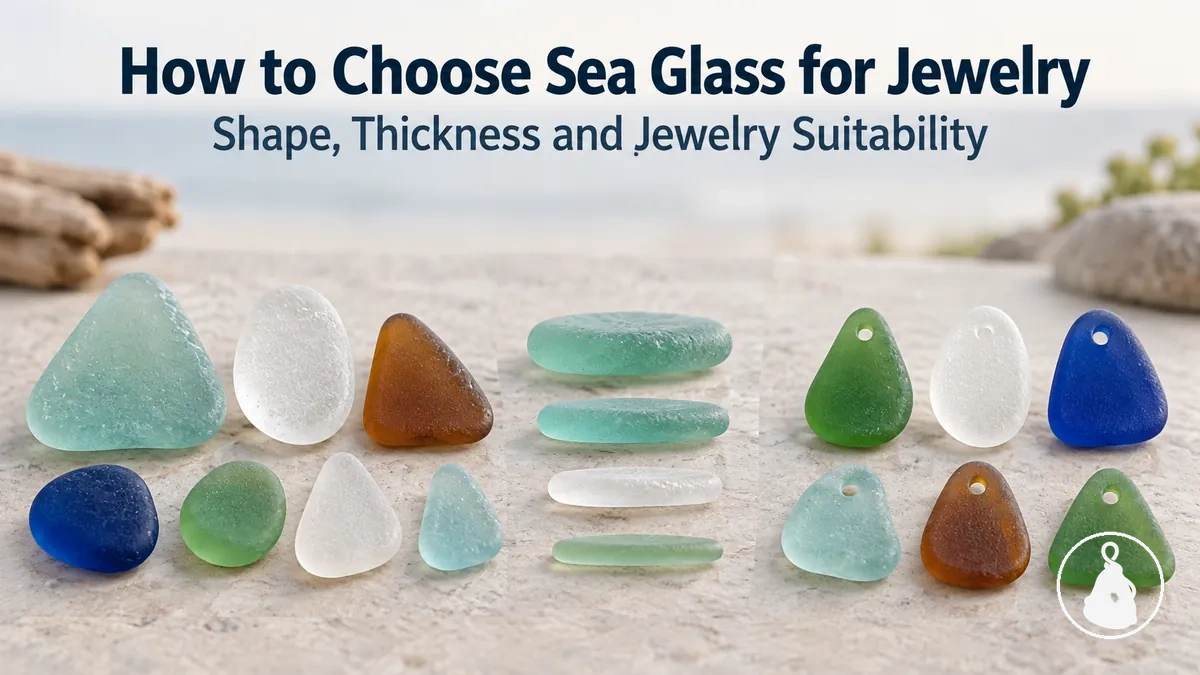
Sea glass selection decision guide
Use the two universal checks first, then follow the route that matches how the piece will be attached. The goal is method fit, not a universal grade.
Look for a combined pattern of surface patina or frosting, softened edge wear, texture variation, and credible provenance. No single mark proves authenticity.
Continue with pieces that have continuous, stable glass where the attachment will act. Cracks, unstable chips, or a weak local area lower suitability.
Then choose the attachment route:
Decision rule: suitability comes from the overlap of authenticity confidence, structural soundness, and method fit. Rarity, colour, or visual distinctiveness are secondary to those conditions.
A visually distinctive piece can still be a poor jewelry candidate if its condition or geometry conflicts with the intended attachment. Select the piece for the job first; treat appearance and rarity as secondary preferences.
Table of Contents
Distinguish Genuine Sea Glass from Artificial or Tumbled Glass
Genuine sea glass is naturally weathered glass; artificial or tumbled glass is deliberately processed to imitate a similar worn finish. Distinguish them by combining several observable clues rather than relying on one feature.
Compare surface texture, edge wear, wear-pattern variation, and provenance together to build identification confidence.
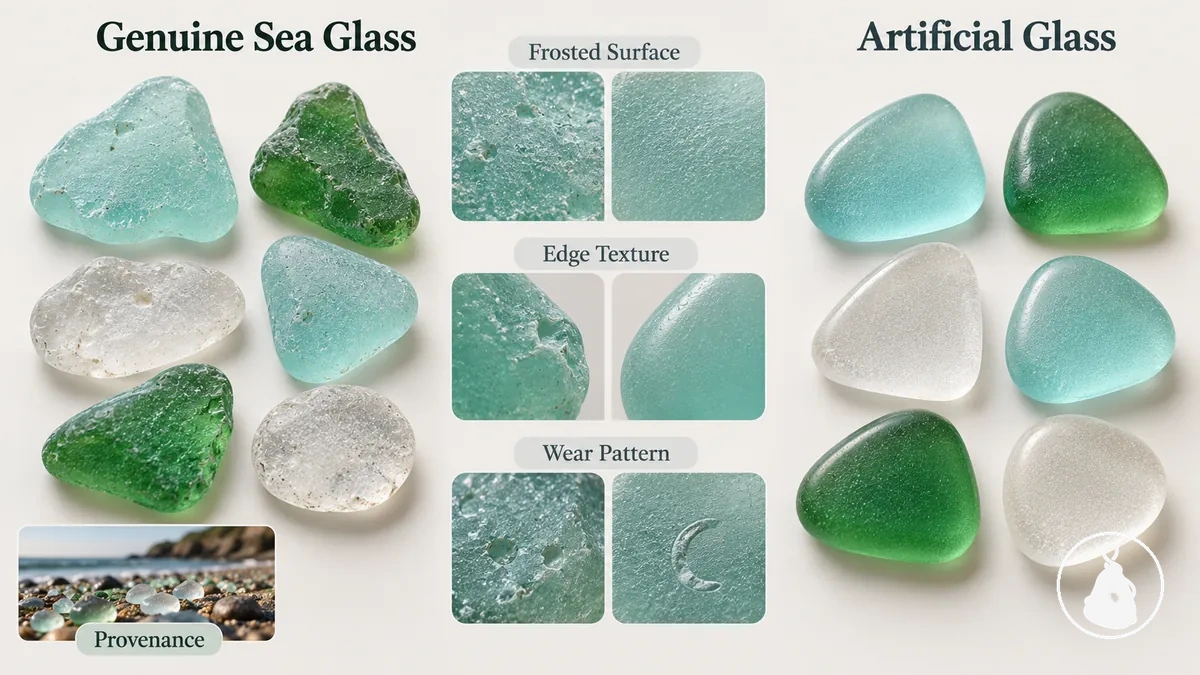
A frosted or patinated surface and softened edges are useful identification cues only when their texture and variation agree with the rest of the piece.
The International Sea Glass Association describes genuine sea glass as tending to show a frosted patina, rounded edges, small crevices, and sometimes C-shaped surface patterns.
Artificial or tumbled glass may show a more uniform texture or manufactured appearance, although processing can imitate natural-looking marks.
Comparing these repeated signals provides more confidence than treating frosting or edge appearance alone as decisive.
| Signal | Genuine sea glass tendency | Artificial or tumbled tendency | Interpretation caution |
|---|---|---|---|
| Frosting | Frosted patina with variation across the surface | Frosted or satin-like finish that may appear more uniform | Artificial processing can mimic frosting, so this clue is not standalone proof |
| Edge texture | Rounded edges with variation across the piece | Edges may show more consistent shaping from deliberate processing | Edge form supports identification only when considered with other observable signals |
| Surface uniformity | Irregular texture, small crevices, and uneven weathering may occur | Surface texture may show greater repetition or manufactured uniformity | Surface uniformity is comparative because processing methods and natural wear can overlap |
| Wear-pattern variation | Wear pattern may combine frosting, rounded areas, crevices, and C-shaped marks | Deliberate tumbling can create natural-looking wear and imitated C-shaped marks | C-shaped marks are clues rather than proof because manufactured glass can mimic them |
| Provenance cues | Credible information about where a piece was found can support its physical characteristics | A seller claim without supporting provenance provides limited verification | Provenance should support rather than replace examination of observable features |
Seller claims and familiar surface marks do not establish authenticity on their own. A description becomes more useful when provenance agrees with the observed surface, edge wear, texture, and wear pattern.
Natural and manufactured features can overlap, including frosting and C-shaped marks. Where the clues conflict, keep the identification conditional and rely on the combined pattern of evidence rather than treating one mark as proof.
Inspect Surface Finish, Edges, and Structural Condition
Inspect each sea-glass piece for surface finish, edge safety, and structural continuity before selecting it for jewelry.
Sound structure and manageable edges matter to jewelry suitability more than colour rarity.
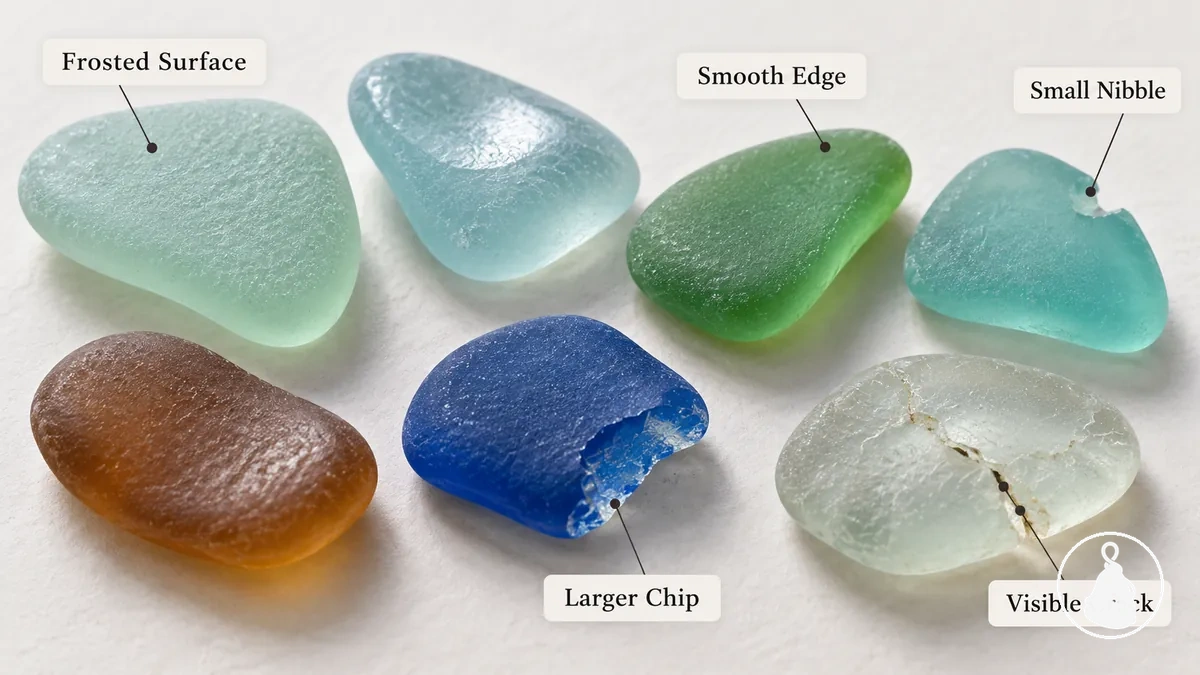
Surface finish describes the visible and tactile state of the glass, including frosted areas, sheen, and local irregularities.
Smooth edges without unstable damage support handling confidence, while nibbles and chips require closer inspection of their depth and location.
A small surface nibble can be mainly cosmetic, whereas damage extending into a weak area raises structural concern.
Check these conditions together using the visible and tactile cues below.
- Frosting or sheen: Note whether the surface is predominantly frosted, shinier, or mixed; surface appearance alone does not establish structural strength.
- Edge smoothness: Smooth edges without sharp or unstable areas support handling confidence and jewelry suitability.
- Small nibbles: Localised shallow edge wear can be cosmetic when the surrounding glass remains continuous and stable.
- Larger chips: A chip that interrupts the edge or leaves an unstable area warrants caution because its location can affect handling and attachment suitability.
- Cracks: A visible crack is a structural concern because it interrupts continuity through the glass and lowers selection confidence.
- Weak areas: Thin, damaged, or visibly unstable areas warrant caution when they occur where the piece would be handled or attached.
- Overall continuity: Continuous glass around the edges and intended attachment area supports stronger selection confidence than connected cracks or unstable damage.
Select pieces whose structure is appropriate for the intended jewelry use, then move to cleaning and other preparation only after the condition check is complete.
Evaluate Shape, Size, and Thickness for Jewelry Suitability
No single shape, size, or thickness is universally suitable for sea-glass jewelry. Evaluate these attributes against the intended attachment and finished jewelry form.
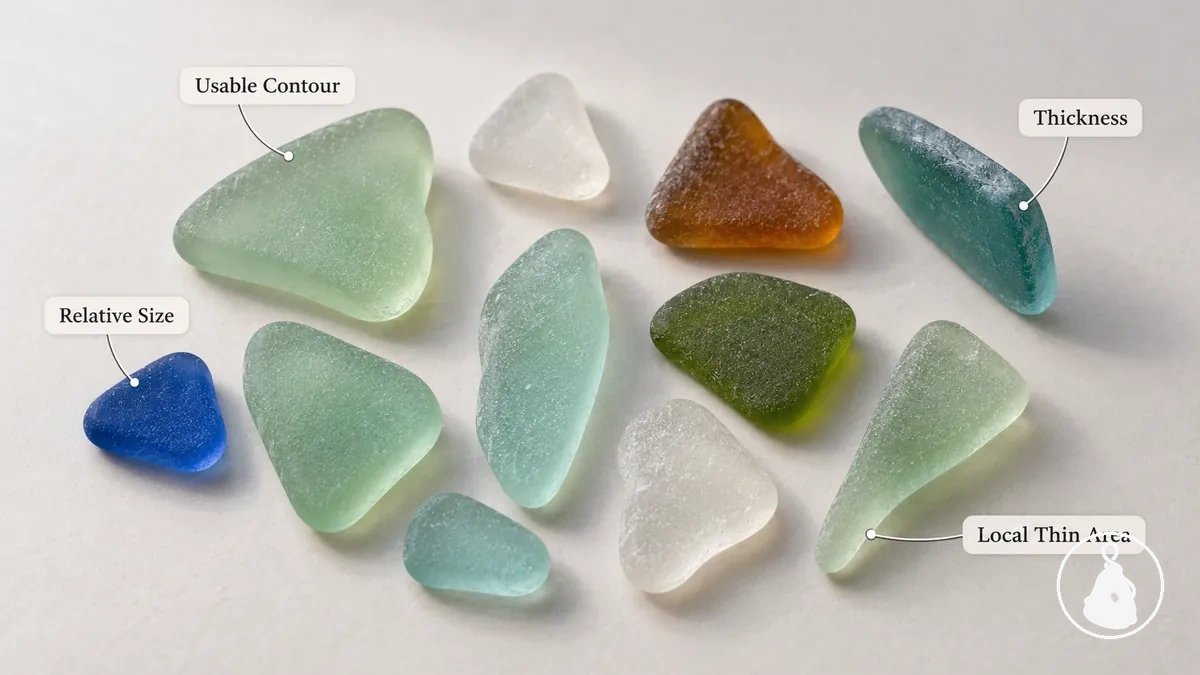
For an irregular shape, the usable contour matters more than whether the outline appears symmetrical or regular.
Broad continuous areas can offer more possible attachment positions, while narrow projections or tight curves can restrict where an attachment engages the piece.
Shape therefore qualifies the usable parts of a sea-glass piece rather than establishing a preferred outline.
Assess the usable contour against the intended attachment rather than treating one shape as suitable for every method.
| Attribute | Condition to inspect | Selection implication | Qualification |
|---|---|---|---|
| Shape or contour | Regular or irregular outline, including broad curves, tight curves, and narrow projections | Determines which parts of the perimeter provide a usable contour for attachment | The useful contour depends on where and how the attachment engages the piece |
| Overall size | Relative length and width of the complete piece | Changes the area and proportions that the intended attachment must accommodate | Individual seller measurements describe particular pieces rather than a general suitability threshold |
| Overall thickness | Consistent or varying profile through the main body of the piece | Changes the amount of glass present at a potential attachment location | The relevant thickness is the condition where the intended attachment interacts with the piece |
| Local thin areas | A taper or noticeably thinner area compared with the surrounding glass | Can make that location less suitable when the attachment would act directly on the thinner area | Assess the local thin area relative to the intended attachment position rather than the piece as a whole |
Overall size does not replace local inspection. A piece can be broad or thick overall yet taper at the exact point where a hole, wrap, or setting would act.
Use seller dimensions to describe the individual piece, not as universal suitability thresholds. Select the piece whose usable contour and local thickness fit the intended attachment.
Match Sea Glass to the Intended Jewelry-Making Method
Match each sea-glass piece to the intended jewelry-making method by assessing geometry, local thickness, edge condition, surface form, and hole status.
Method fit is conditional: the same piece can suit one attachment route and be a poor candidate for another.
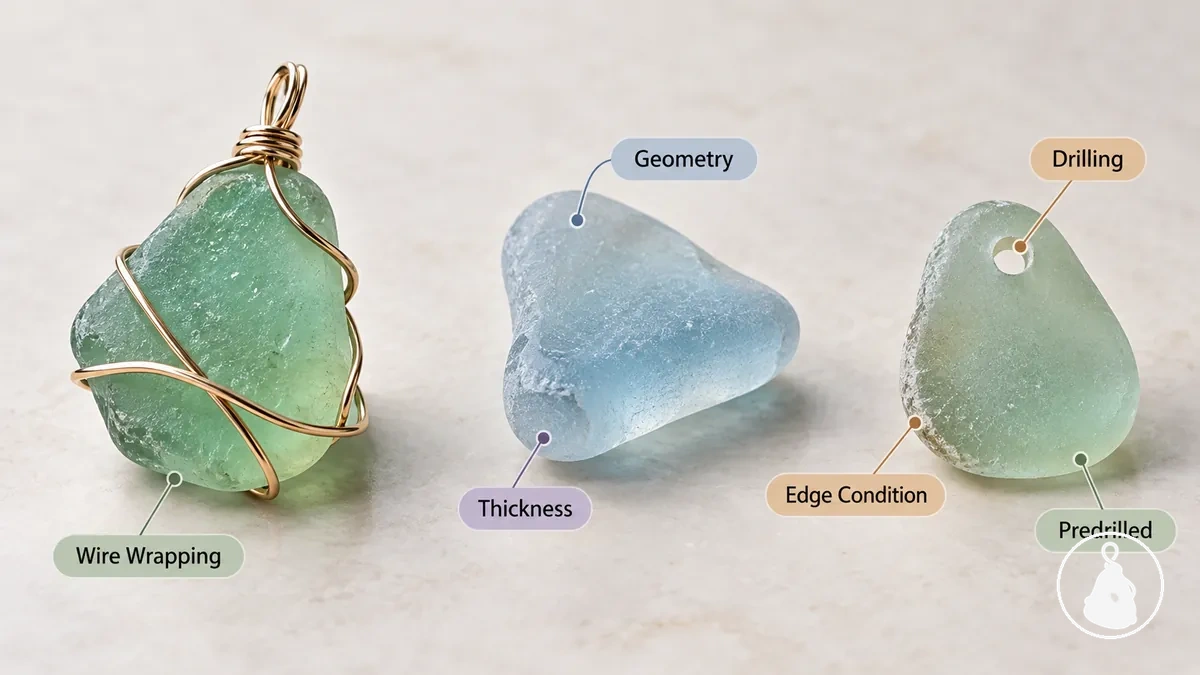
- Geometry and surface form
- Determine where an attachment can engage and whether the piece offers usable capture or placement areas.
- Local thickness
- Qualifies the exact area where drilling or another attachment would act; an obvious thin taper can reduce suitability at that location.
- Edge condition
- Stable, continuous edges support handling and attachment; cracks or unstable damage near the working area are warning conditions.
- Hole status
- Predrilled glass fixes the hole position and size; undrilled glass preserves more placement and method choices.
Use the method-specific checks below to decide whether the individual piece fits drilling, wire wrapping, or an existing drilled opening.
Suitability for Drilling
Drilling suitability depends on sound glass around the proposed hole area, not on overall appearance.
Inspect the proposed location for enough intact material to support selection confidence.
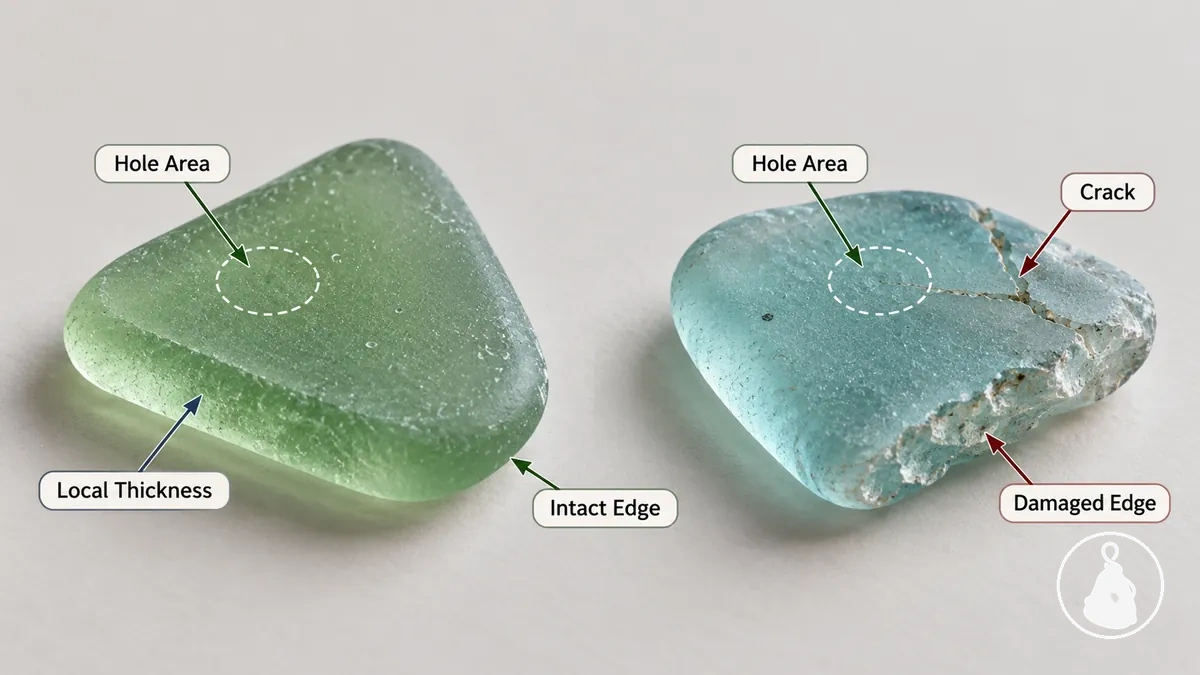
- Hole area: Choose a location surrounded by continuous, visibly intact glass.
- Local thickness: Prefer an area without an obvious thin taper or abrupt thickness change.
- Damaged edge: Nearby chips or unstable edge damage reduce selection confidence around that location.
- Crack: A visible crack near the proposed location interrupts structural continuity.
- Structural continuity: Prefer continuous glass between the proposed hole area and nearby edges.
Visible cracks, unstable edge damage, or a fragile local taper are reasons to choose a different hole location or a different piece. This check screens the glass before the separate drilling process begins.
Suitability for Wire Wrapping
Wire-wrapping suitability depends on geometry that lets the intended wrap capture and retain the sea-glass piece.
Look for a usable contour and stable edges rather than one preferred shape.
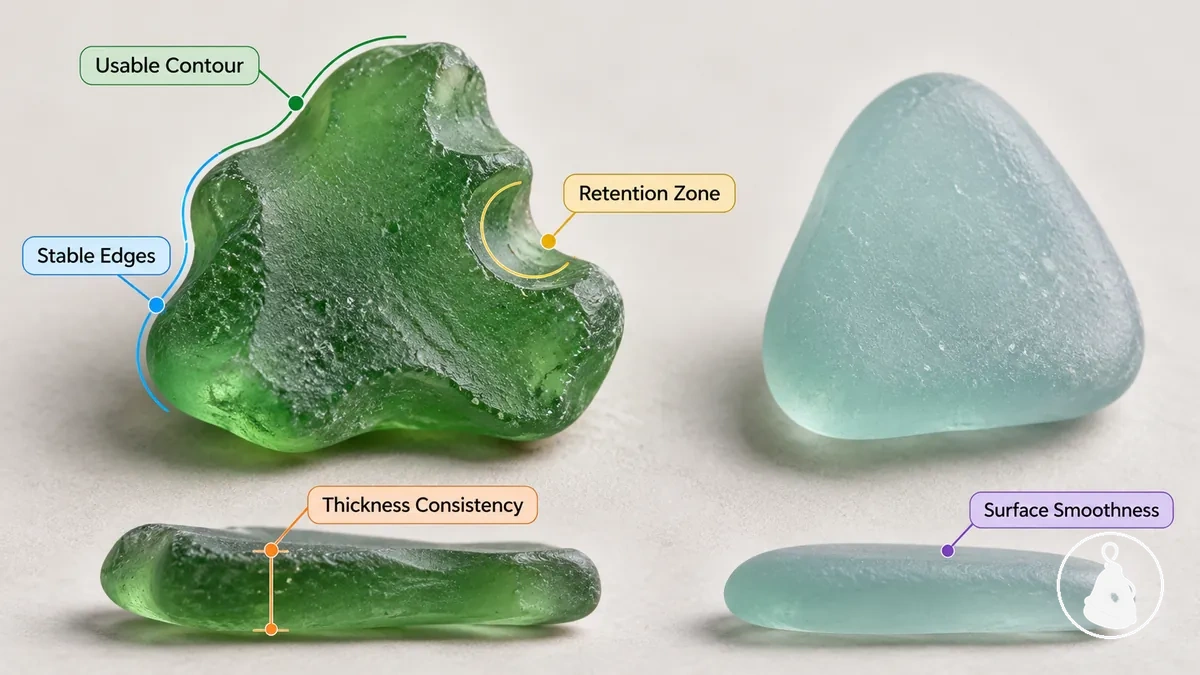
- Contour changes
- Pronounced, stable contour transitions can give a wrap useful places to resist slipping.
- Thickness consistency
- More consistent thickness can support steadier contact, while abrupt thickness changes alter how the wire meets the glass.
- Surface profile
- A very smooth, uniform profile may offer fewer natural retention zones than a piece with usable contour changes.
- Security condition
- Retention remains dependent on the exact geometry engaged by the intended wrap; shape alone does not guarantee security.
Select a piece whose visible profile offers practical capture points for the intended wrap. This is a fit check for the glass, not a substitute for the separate wire-wrapping technique.
Predrilled vs Undrilled Sea Glass
Predrilled sea glass reduces one preparation task but fixes the available hole position and size.
Undrilled sea glass preserves greater placement and method flexibility because no opening has been fixed.
| Factor | Predrilled sea glass | Undrilled sea glass | Selection implication |
|---|---|---|---|
| Hole presence | An attachment hole is already present | No attachment hole is present | Predrilled pieces offer convenience, while undrilled pieces retain more preparation choices |
| Hole placement | Placement is fixed and must suit the intended attachment | Placement is not predetermined | A fixed position limits attachment choices when it does not align with the intended attachment |
| Hole size | The existing hole size is fixed | No hole size has been established | The drilled opening must suit the intended attachment rather than serve as a universal fit |
| Chipping or nearby cracks | Visible chipping or nearby cracks around the hole reduce selection confidence | There is no existing hole to inspect for hole-related damage | Damage around an existing hole increases rejection risk for that drilled piece |
| Remaining material | Material surrounding the hole should remain visibly continuous and intact | Remaining material is not interrupted by an existing hole | The condition around a drilled opening helps determine its suitability for the intended attachment |
| Attachment flexibility | The existing hole constrains where a hole-based attachment can engage | The absence of a hole preserves more placement and method choices | Select according to whether convenience or attachment flexibility better serves the intended attachment |
For a predrilled piece, inspect hole placement, hole size, chipping, nearby cracks, and the continuity of the glass around the opening. The fixed hole is useful only when those conditions suit the intended attachment.
Choose predrilled glass when the existing opening already fits the design and reduces preparation. Choose undrilled glass when greater placement choice or a different attachment route matters more.