Planning a Balanced and Wearable Sea Glass Jewelry Design
Plan a sea-glass jewelry design from the glass outward: check contour, thickness, edge profile and usable support areas first; then confirm setting fit, compare proportion and orientation within the complete necklace, and test the finished piece for comfortable, stable wear. There is no universal shape, size or orientation that is automatically balanced—the workable choice depends on the specific piece and its intended wearing context.
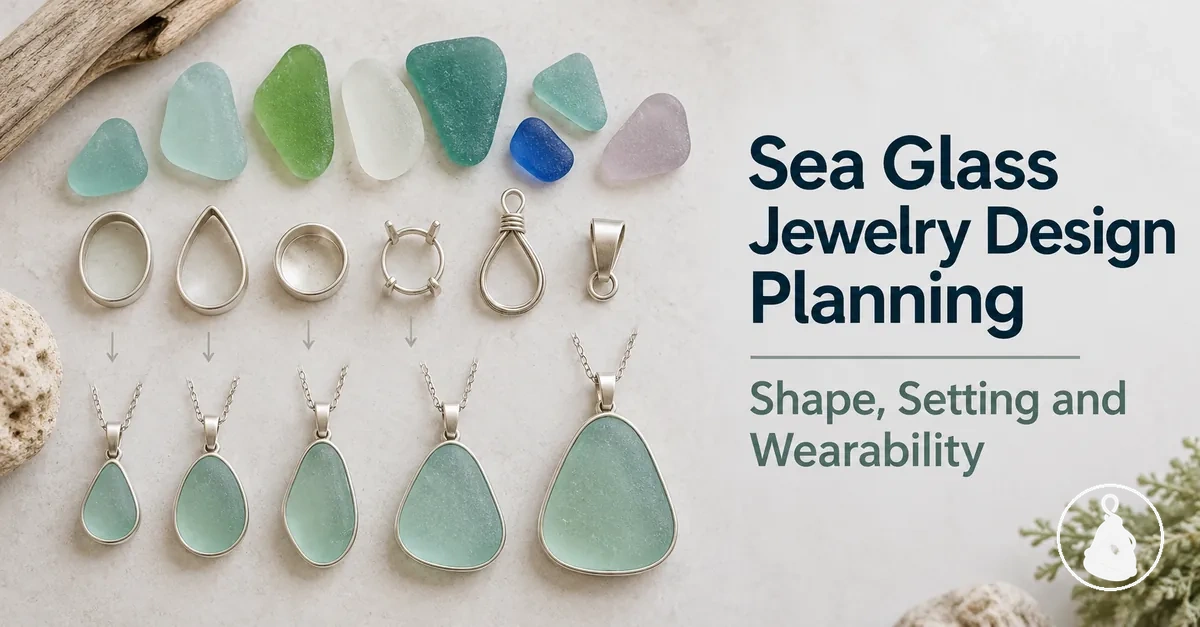
Sea glass design planning sequence
Use these four checks in order. Each one closes a different design relationship before the next is judged.
-
Read the glass geometry Inspect: contour, thickness, edge profile and usable support areas. Continue when: at least one orientation provides workable contact or support areas for the intended setting approach.
-
Match the setting geometry Inspect: available capture/contact geometry and depth against the actual piece. Continue when: support can align with usable areas without a contour or depth conflict.
-
Judge proportion and orientation Inspect: glass dimensions, setting footprint, overall drop, necklace scale, apparent width, height and focal direction. Continue when: the composition reads as balanced in its necklace context while retaining workable support.
-
Verify wearability Inspect: total weight, projection, movement, edge contact and suspension behaviour. Continue when: the piece feels manageable, hangs acceptably and avoids intrusive contact during intended wear.
Decision rule: if physical support or wearability fails, adjust the setting, orientation, scale or configuration before treating visual balance as resolved.
Scope: this page evaluates design relationships; fabrication procedures are separate.
Table of Contents
Sea Glass Shape Sets the Design Constraints
A sea-glass piece's shape determines where a setting can make useful contact and which orientations remain practical. Evaluate the actual piece rather than relying on a shape label or nominal size.
- Contour
- A closely followable outline can provide broader, more continuous contact; pronounced curves, angles or irregular transitions can restrict support to selected areas.
- Thickness
- The piece's actual depth must fit the proposed setting's available depth or capture geometry. A depth conflict makes that setting geometry unsuitable.
- Edge profile
- Support has to meet an edge condition the setting can accommodate. Uneven transitions can change where contact remains practical.
- Usable support areas
- These are the workable contact or capture regions that determine feasible support positions and help narrow the possible orientations.

Two pieces with similar face size can therefore impose different constraints: a followable contour may offer several continuous contact areas, while an irregular piece may provide only selected support regions. Judge geometry before setting fit or visual proportion so later decisions stay within the piece's physical constraints.
Irregular Shapes Can Be Designed Around Without Reshaping
An irregular piece does not need to be regularised simply because its outline is asymmetric. Rotation can change both its visual direction and which edge transitions fall near the intended support region.

Setting Compatibility Depends on Contour, Thickness and Edge Support
Setting compatibility is a fit relationship between the actual sea-glass geometry and the proposed setting geometry. Shape name alone cannot establish compatibility: contour, thickness and usable edge or contact areas must correspond with the setting's capture or support conditions.
A closely followable contour can distribute contact across more of the available edge, while an irregular contour can concentrate support at selected points. A thickness/depth mismatch makes a proposed geometry unsuitable even when the face size appears to fit.

Compatibility matrix
| Sea-glass attribute | Condition to inspect | Support requirement | Design implication |
|---|---|---|---|
| Contour | Closely followable outline | Support can correspond with more of the available edge | Setting geometry can provide more continuous contact with the piece |
| Contour | Irregular outline | Support must correspond with usable contact points | Compatibility requires setting geometry that can capture those areas |
| Thickness | Piece depth conflicts with available setting depth | Setting geometry must accommodate the actual thickness | The depth conflict makes that geometry unsuitable for the piece |
| Edge support | Usable edge contact is localised | Support must align with those usable edge areas | Compatibility requires corresponding support points in the setting geometry |
Two nominally similar pieces can therefore need different capture points or usable depth. Nominal size is not a substitute for checking contour, thickness and edge support on the actual piece. Detailed comparison of setting types is a separate task; this section determines whether a proposed setting geometry fits this piece.
Pendant Proportion Depends on Glass Size and Necklace Scale
Pendant proportion is relational rather than governed by one universal measurement. Judge the complete pendant against the necklace context, not the glass dimensions in isolation.
The main variables are glass dimensions, setting footprint, overall drop and necklace scale. A setting that extends farther beyond the glass increases apparent pendant scale, while a longer overall drop strengthens vertical emphasis; a more visually substantial necklace can make the same pendant read as more understated.

Relative-scale matrix
| Design variable | Relative condition | Visual effect | Planning implication |
|---|---|---|---|
| Glass dimensions | Greater relative to the surrounding pendant structure | More visually dominant glass | Judge the glass against the complete pendant silhouette |
| Setting footprint | Extends farther beyond the glass outline | Greater apparent pendant scale | Evaluate the complete footprint rather than glass size alone |
| Overall drop | Greater relative to pendant width | Stronger vertical emphasis | Include the complete drop when judging relative scale |
| Necklace scale | More visually substantial relative to the pendant | Pendant appears more understated | Judge visual balance within the complete necklace context |
The same pendant can therefore appear dominant on a visually delicate necklace and more understated on a more substantial one. No single numerical cutoff determines balance across all designs; the useful value is the pendant's relative scale within the intended necklace.
Orientation Changes the Visual Balance of the Finished Design
Orientation changes how the same sea-glass piece distributes apparent width, height, asymmetry, focal direction and visual mass. Compare orientations with the piece and scale held constant so the effect of rotation is clear.

Vertical orientation
Emphasises apparent height and the longer visual axis. Rotating into this position can also place a different contour or edge transition near the intended support area.
Horizontal orientation
Emphasises apparent width and redistributes asymmetry and visual mass laterally. The change can make different support areas more or less usable.
Neither orientation is universally more balanced. Choose the orientation that works with both the surrounding composition and a usable support position.
Wearability Depends on Total Weight, Movement and Body Contact
Wearability is the final design check because appearance alone cannot show how a finished piece behaves on the body. Evaluate total weight, projection, movement, edge contact and suspension behaviour together in the intended wearing context.
An acceptable design should feel manageable, avoid repeated uncomfortable contact and maintain a sufficiently stable hang for its intended use. These are performance conditions rather than universal numerical thresholds.

Wearability check
- Total weight: Observe whether the finished piece feels burdensome during intended wear; if it does, the weight is reducing physical comfort.
- Projection: Observe how the pendant sits against the body; awkward or intrusive projection indicates that its physical configuration needs adjustment.
- Movement: Observe the pendant during normal movement; excessive swing for the intended context can reduce comfort or stability.
- Edge contact: Observe where the piece meets the body; repeated uncomfortable edge contact indicates a need for adjustment or rejection.
- Suspension behaviour: Observe whether the piece maintains a stable hang; repeated shifting from its intended orientation indicates unstable suspension for that wearing context.
A sea-glass pendant can look visually balanced and still fail this check. If it feels burdensome, projects awkwardly, swings excessively, repeatedly contacts the body uncomfortably or cannot maintain its intended hang, the design needs adjustment even when its appearance is satisfactory.
This wearability check concerns wearing behaviour rather than jewelry care or material durability.