Caring for Finished Sea Glass Jewelry
Care for finished sea glass jewelry as a complete construction, not as sea glass alone. Inspect the attachment first, then use the gentlest cleaning method compatible with the metal finish and attachment; control moisture around wraps, settings, and bonds, keep metal polish off the frosted glass, and dry the piece fully. Pause cleaning—and pause wear when attachment security has visibly changed—if the glass, setting, bond, or connecting hardware is loose, lifting, cracked, detached, or progressively moving.
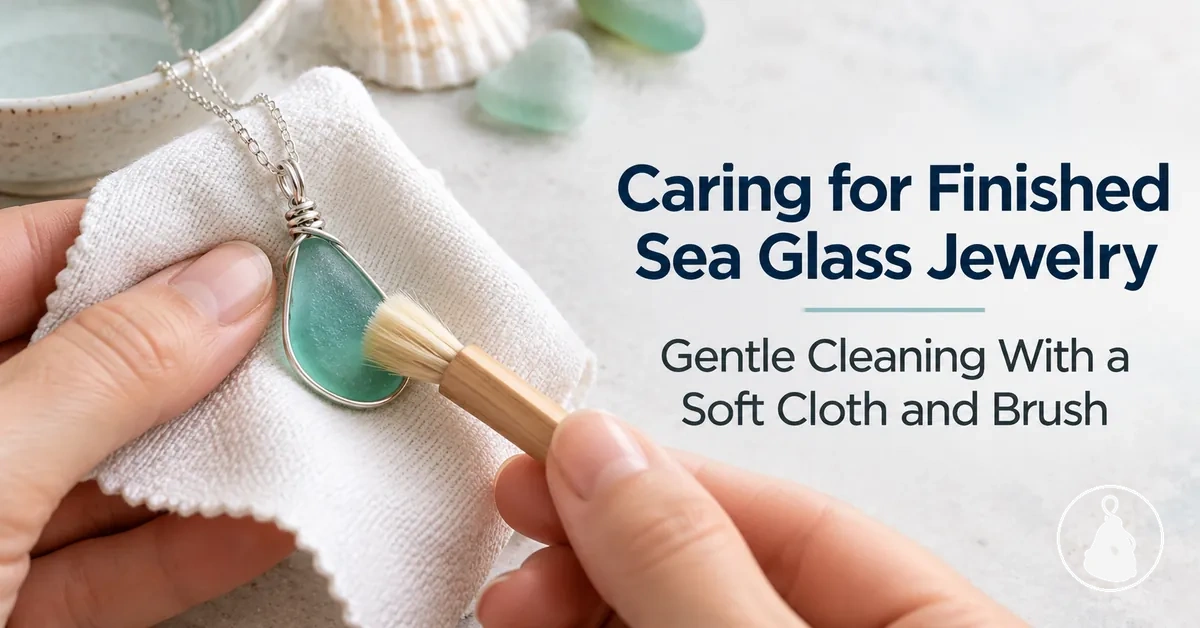
Safe care decision guide
Use the most vulnerable part of the finished construction to set the care limit. The sea glass may tolerate treatment that a metal finish, setting, wire wrap, or adhesive bond does not.
- Inspect security firstLook for movement, gaps, lifting, cracks, corrosion, loose wire, or opening hardware before adding moisture, cleaner, or pressure.
- Match cleaning to the attachmentSecure wire wraps and settings can take gentle cloth or brush contact when the attachment is stable and the finish is compatible; adhesive-mounted pieces need stricter control of moisture, heat, solvents, and rubbing when bond tolerance is unknown.
- Control water, chemicals, and polishDo not assume immersion or a cleaner is suitable for the whole piece. Keep metal-polishing friction on compatible metal surfaces and away from the intended frosted glass finish.
- Dry, store, and recheckDry accessible seams and attachment areas, store the piece dry and separated from harder objects, then recheck the attachment before normal wear.
Safer default when compatibility is uncertain: use controlled surface cleaning rather than prolonged immersion, stronger chemicals, or added mechanical pressure.
Table of Contents
Clean Finished Sea Glass Jewelry According to Its Construction
Clean finished sea glass jewelry according to its construction and the condition of its attachment method.
Gentle cleaning can use mild soap, a soft cloth, or a soft brush when those contacts suit the metal finish and attachment, but visible movement, looseness, or uncertain attachment security is a reason to stop before adding moisture or pressure.
Mechanically secured pieces can accept cleaning contact according to the security and finish of the construction, while adhesive-mounted pieces require moisture and pressure to be controlled around the bond when its tolerance is unknown.
Some finished constructions also limit rinsing or immersion because moisture can reach enclosed areas or remain around settings and attachments.
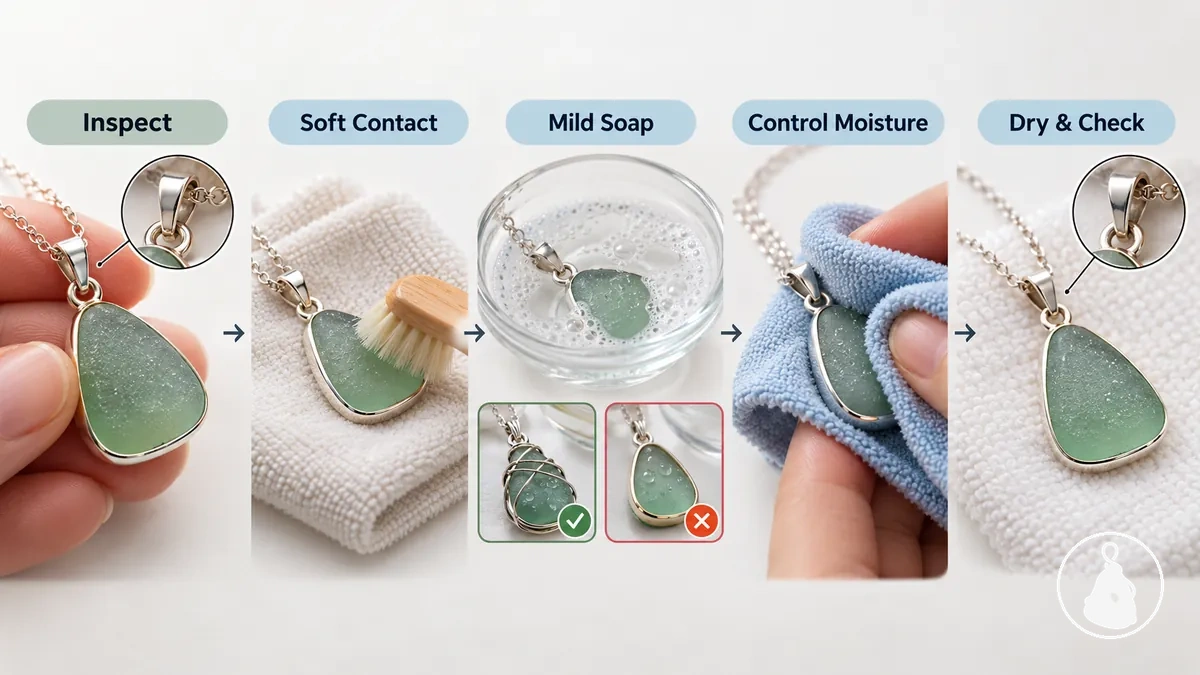
Clean the finished piece according to those construction differences, using the following sequence to organise inspection, gentle cleaning, moisture control, and drying.
- Inspect the attachment first. Check the setting, wrap, bond, and nearby metal components for visible movement, gaps, or looseness. If the sea glass or attachment moves under gentle handling, stop cleaning rather than applying additional moisture or pressure.
- Remove loose debris with gentle contact. Wipe the sea glass surface and accessible metal with a clean soft cloth, or use a soft brush where its bristles can reach residue without catching a wire, edge, or attachment. Stop if the tool shifts the glass or catches on the construction.
- Use mild soap and controlled moisture when the construction permits it. Apply the cleaning contact to the dirty surface rather than automatically immersing the finished piece; this limits moisture around bonds, settings, and finishes whose water or cleaner tolerance is uncertain.
- Remove cleaning residue according to the construction. Rinse only when the finished piece is known to tolerate that exposure; otherwise, use a damp soft cloth to lift away soap and residue while controlling moisture around vulnerable attachments.
- Dry the piece and recheck its security. Remove accessible moisture with a dry soft cloth and allow areas around settings or attachments to dry before storage or wear. Recheck the sea glass and attachment method afterward, and stop further cleaning if either has become loose or changed position.
Drying should address the attachment and setting as well as the visible sea glass surface because moisture can remain in less accessible parts of the jewelry construction.
Once the finished jewelry is dry, recheck its attachment security before returning it to normal handling or attempting further cleaning.
Clean Wire-Wrapped Sea Glass Without Disturbing the Wrap
Clean wire-wrapped sea glass by lifting surface dirt without shifting the wire wrap or abrading its contact points.
Before applying cleaning pressure or moisture, check that the wrap is tight around the glass, exposed wire edges are stable, and the wire finish or coating shows no visible scratching or damage.
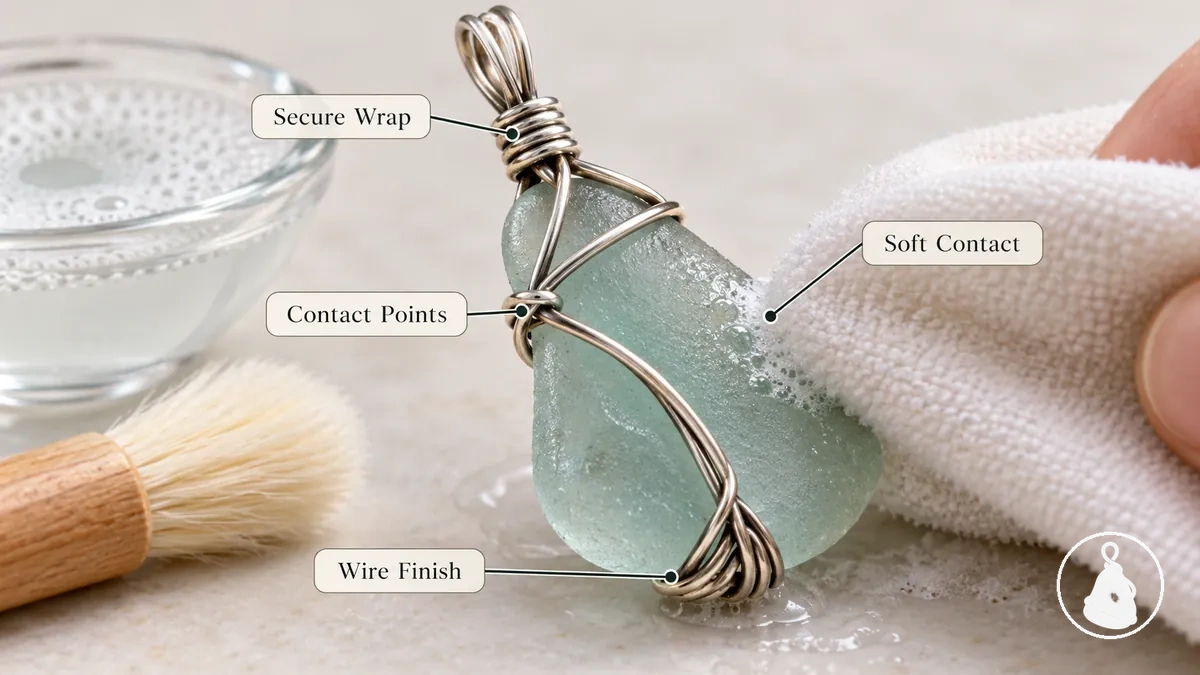
- Clean with
- A soft cloth or soft brush with light contact when the wrap is secure and the wire finish is compatible. Mild soap and water are conditional on the wire material or coating.
- Control
- Limit moisture around wire crossings and contact points, then dry the wrapped piece so water does not remain against the wire setting.
- Stop when
- Looseness, visible movement, scratching, or coating damage appears; avoid extra cleaner exposure or pressure until the setting can be assessed.
Clean Glued Sea Glass Without Weakening the Bond
Clean adhesive-mounted sea glass conservatively because the bonded joint limits how much moisture, solvent, heat, and rubbing the piece should receive.
Cleaner and moisture tolerance cannot be assumed across different adhesives, so inspect the bond condition first for visible lifting, gaps, separation, or movement before routine cleaning.
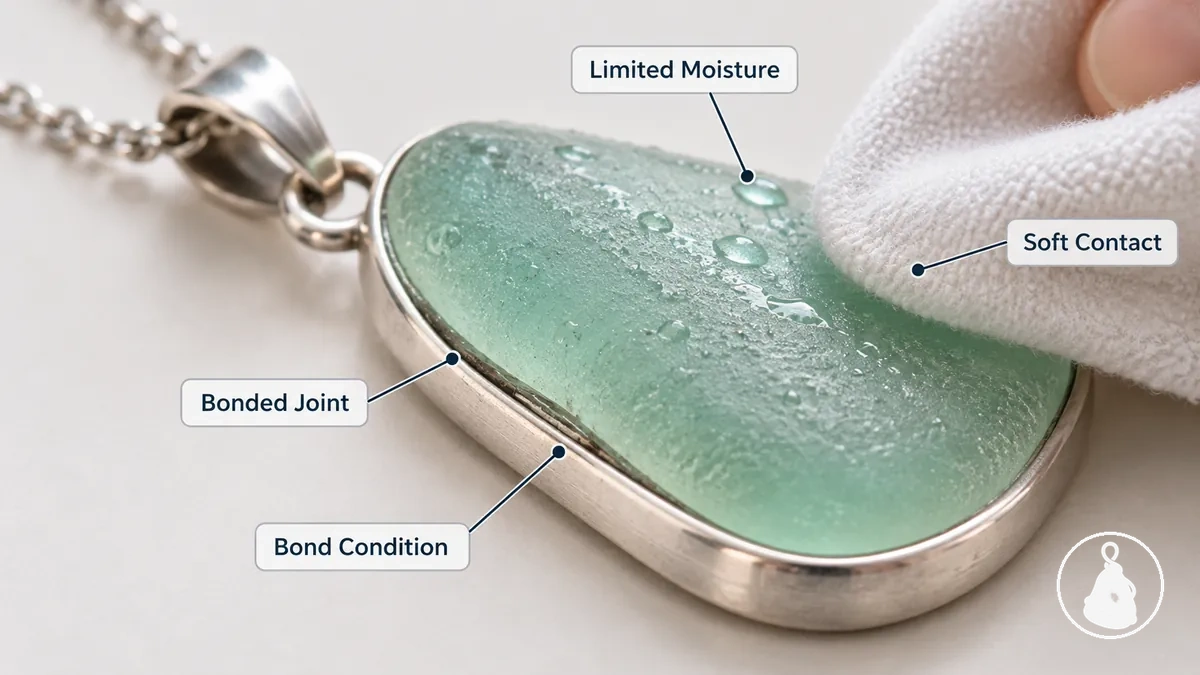
- If the bond is sound
- Use a soft cloth and gentle surface cleaning on exposed areas while limiting moisture and mechanical stress at the bonded joint.
- Do not assume compatibility
- Solvents or heat can soften or cloud some adhesives; immersion can weaken or lift water-sensitive bonds, and heavier rubbing can add mechanical stress. A treatment that suits the glass may still be unsuitable for the bond.
- Stop when
- Separation, lifting, a developing gap, or visible movement is present; do not add more cleaner, moisture, heat, or rubbing to the joint.
Clean Bezel-Set Sea Glass Without Stressing the Setting
Clean bezel-set sea glass by lifting residue from the sea glass surface and bezel edge without levering or shifting the metal setting or trapping moisture around the setting edge.
Before cleaning, check how evenly the bezel contacts the glass and note any visible gap, trapped residue, or movement that could make direct cleaning pressure inappropriate.
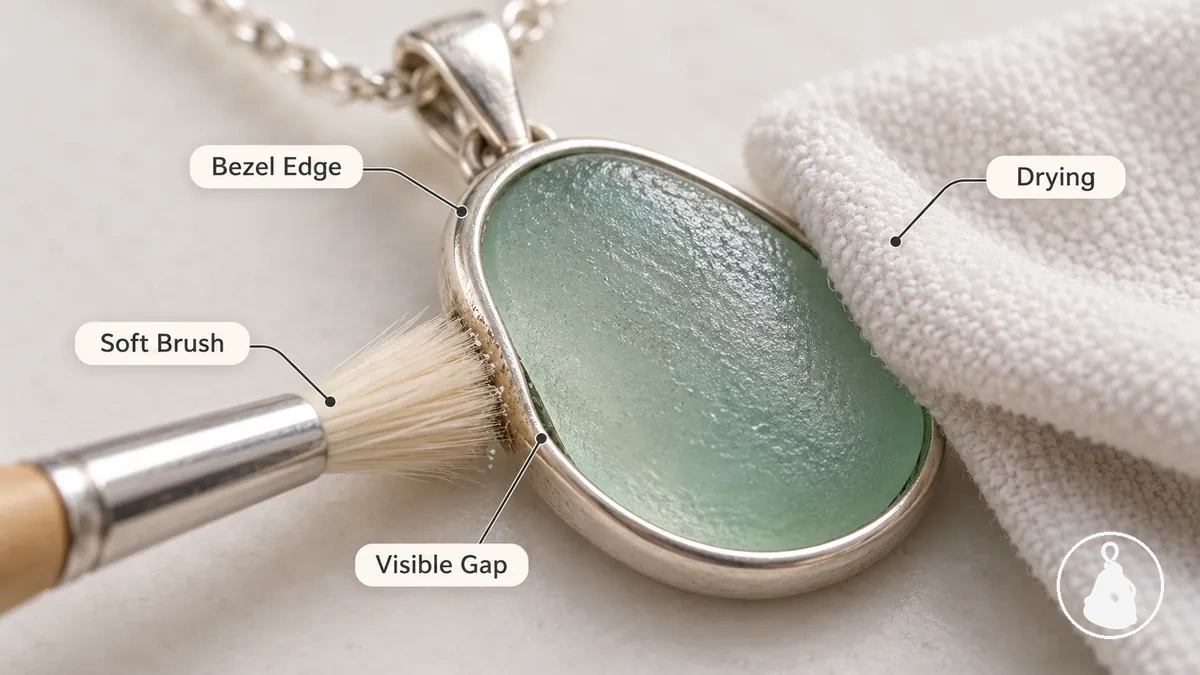
- Clean with
- A soft brush or soft cloth when the bezel is stable and the metal finish is compatible; do not force the tool beneath the bezel edge.
- Control
- Use mild soap only when the setting and finish tolerate it, limit moisture around visible gaps, and dry the glass, bezel edge, and accessible seams.
- Stop when
- The glass moves or the setting becomes visibly loose. Have the setting assessed rather than treating instability as a cleaning problem.
Manage Water and Chemical Exposure for Finished Sea Glass Jewelry
Finished sea glass jewelry can have different water exposure limits from the sea glass itself because the complete jewelry construction also includes metal, wire, settings, or an adhesive joint.
Whether wet contact is appropriate therefore depends on the metal finish and attachment method rather than on the glass alone.
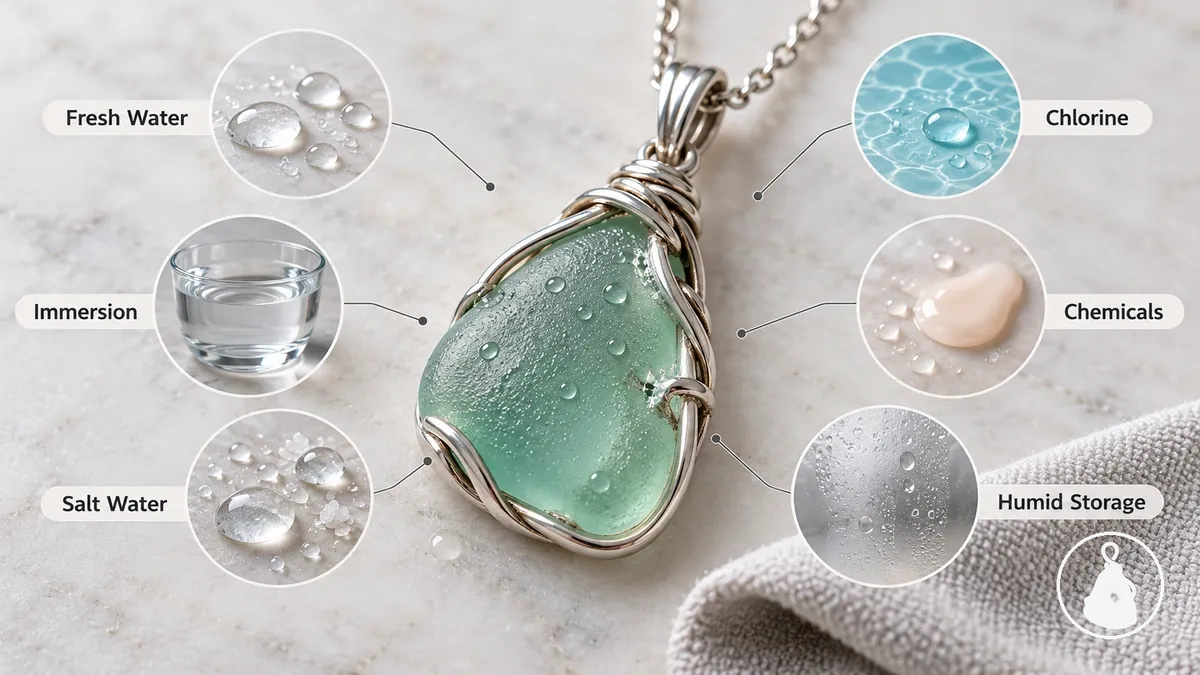
Brief fresh water contact and prolonged immersion are different exposure conditions when moisture can remain around a setting or adhesive joint, while salt water, chlorine, soaps, cleaning chemicals, cosmetics, and humid storage can also affect metal finishes or attachment areas.
Construction-specific exposure limits should therefore determine how the finished piece is handled, as summarized below.
| Exposure type | Affected component | Risk condition | Safer response |
|---|---|---|---|
| Brief fresh water | Metal, wire, setting, or adhesive joint | Moisture reaches seams, enclosed settings, or a bond whose water tolerance is unknown | Limit wet contact according to the construction and dry accessible surfaces and attachment areas afterward |
| Prolonged immersion | Setting or adhesive joint | Longer moisture exposure reaches enclosed areas or a bonded joint with unknown immersion tolerance | Do not assume immersion is suitable; use controlled surface cleaning when the construction's tolerance is uncertain |
| Salt water or chlorine | Metal finish, wire, or setting | Salt or chlorinated water contacts a metal or finish whose exposure tolerance is not established | Limit exposure, clear accessible residue with a compatible rinse or damp wipe, and dry the piece |
| Soaps or cleaning chemicals | Metal finish or adhesive joint | The cleaner is not known to be compatible with the finish or bonded attachment | Use a cleaner only when it is compatible with the construction and limit unnecessary chemical contact around vulnerable attachment areas |
| Cosmetics | Metal finish, wire, or attachment area | Product residue remains on surfaces or collects around seams and settings | Wipe accessible residue from the finished jewelry with a soft cloth appropriate for the surface |
| Humid storage | Metal components and enclosed setting areas | Moisture persists around metal surfaces, seams, or enclosed areas | Store the jewelry dry after residual moisture around settings and attachments has dissipated |
The useful distinction is between incidental moisture that can be promptly cleared from a compatible construction and repeated or prolonged exposure that gives moisture or residue more opportunity to remain around metal finishes and attachment areas.
Treat the finished construction as the limiting condition: when the metal finish, setting, wire, or adhesive joint has uncertain exposure tolerance, choose controlled contact and thorough drying rather than assuming the sea glass determines the care rule.
Polish Metal Components Without Changing the Sea Glass Surface
Polishing metal components and deliberately altering the sea glass surface are different maintenance actions.
Gentle polishing should target the jewelry metal while limiting polishing contact with the intended frosted surface, with the metal type and metal finish determining whether a particular polishing cloth or method is appropriate.
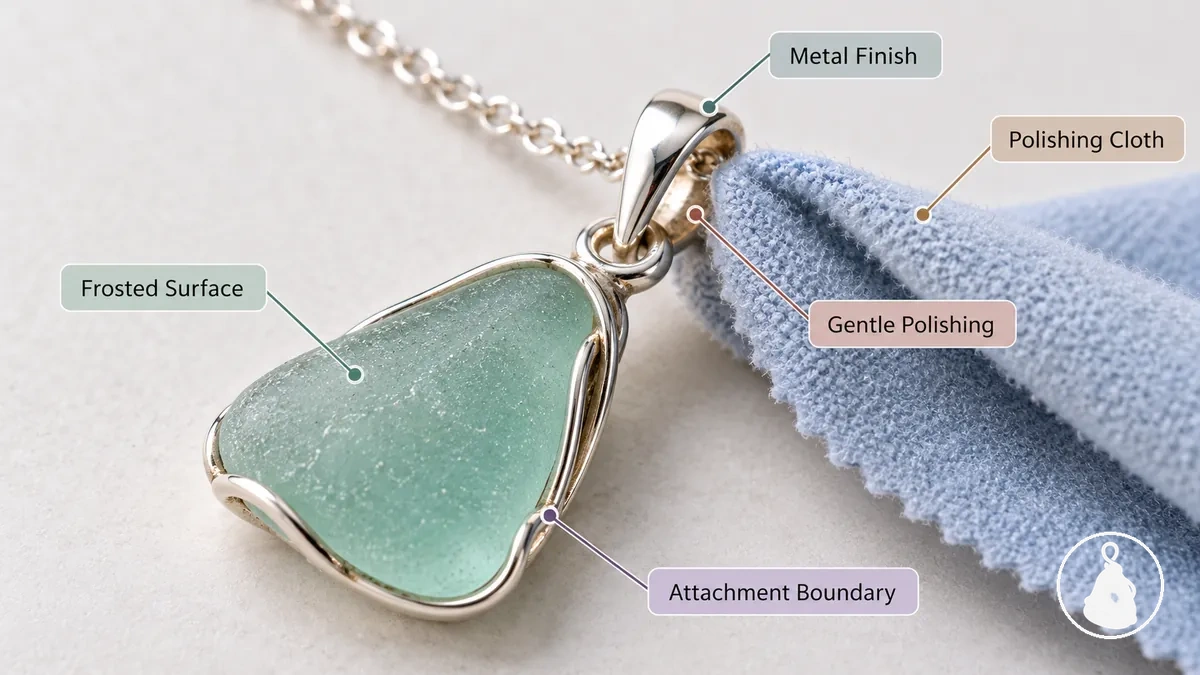
Controlled polishing contact separates metal brightening from abrasion of the adjacent sea glass surface and from unnecessary contact with a setting, wire, or adhesive boundary.
Because metals, coatings, and finishes can require different polishing methods, use a polishing cloth or method only when it is suitable for that metal finish, then confine the working area to the metal component using the following sequence.
- Identify the metal and finish. Determine which metal component is being polished and whether its finish or coating is compatible with the intended polishing cloth or method before applying friction.
- Confine gentle polishing to the metal. Work on an accessible metal area with controlled contact, keeping the polishing cloth away from the frosted sea glass surface and limiting pressure around wire, setting edges, or an adhesive attachment.
- Control contact at boundaries. Where metal meets the sea glass or attachment, reduce polishing contact rather than carrying the same motion across the glass, bond, or coated surface.
- Clear residue and reassess the finish. Lift polishing residue from accessible metal and adjacent areas without rubbing it across the sea glass, then check whether the resulting shine is appropriate for that particular metal finish.
After polishing, clear accessible residue from around the setting, wire, adhesive boundary, and sea glass surface, then reassess the metal finish.
The achievable shine depends on the metal and its finish, so stop according to the condition of that component rather than pursuing a fixed shine level.
The maintenance objective is controlled metal brightening while retaining the intended frosted surface of the finished sea glass.
Store Sea Glass Jewelry to Prevent Tarnish, Scratches, and Chipping
Store finished sea glass jewelry dry, separated from harder jewelry and surfaces, and protected from impact or strain at its attachment points.
Moisture and humidity can promote tarnish on susceptible metal components, while rubbing or impact against harder objects can increase the risk of scratches or chipping.
Loose communal storage allows pieces to rub, shift, or strike one another, whereas separated dry storage limits those contact conditions without eliminating damage or tarnish risk.
A suitable storage spot should therefore limit humidity or steam exposure, friction, impact, and unnecessary tension on wraps, settings, or bonded joints; use the following checks when putting a piece away.
- Dry before storage. Put sea glass jewelry away after accessible moisture has dried, and choose a storage spot with reduced humidity or steam exposure to limit conditions associated with metal tarnish.
- Keep pieces separated. Use separate compartments, an individual pouch, or another arrangement that limits rubbing against harder jewelry and surfaces that could contribute to scratches or chipping.
- Limit movement and impact. Position each piece so it is less likely to shift, fall, or strike a hard surface during storage or handling.
- Avoid strain at attachment points. Arrange chains and finished pieces so wraps, settings, and bonded joints are not stored under sustained pulling or pressure.
These storage conditions reduce exposure to factors associated with tarnish, scratches, chipping, and attachment strain rather than eliminating those risks.
Before putting a piece away, check that it is dry, separated from harder objects, supported without tension at its attachment points, and positioned where routine handling is unlikely to cause rubbing or impact.
Inspect Attachment Points for Loosening and Wear
Inspect attachment points when finished sea glass jewelry shows visible movement, gaps, looseness, cracking, lifting, corrosion, or other wear before continued wear or cleaning places additional stress on the piece.
The inspection subject is the attachment point itself: the wire wrap, bezel setting, adhesive joint, or connecting hardware that keeps the finished construction together.
A visible inspection checks each attachment type for observable changes in attachment security rather than establishing the condition of hidden parts.
Movement or a developing gap can indicate a change in security, while abrasion, lifting, corrosion, or cracking warrants checking the affected component for separation or progressive wear; the checklist below maps each visible warning sign to a check and next action.
| Attachment type | Visible warning sign | Check | Next action |
|---|---|---|---|
| Wire wrap | Looseness, shifted wire, abrasion, or increasing movement around the sea glass | Check whether the wrap remains in position and whether the glass moves within it under gentle handling | Pause normal wear if the glass is clearly loose or movement is progressing, and have the attachment security assessed |
| Bezel setting or other setting | A developing gap, lifted edge, cracking, corrosion, or movement between the glass and setting | Check the setting edge for changed contact with the glass and observe whether the glass shifts during gentle handling | Seek assessment before continued wear when the glass is loose, the setting is cracked, or separation is progressing |
| Adhesive joint | Lifting, a developing gap, cracking, partial detachment, or movement at the bonded joint | Inspect the bond line for visible separation and check whether the attached parts move relative to one another | Stop wearing the piece when detachment, cracking, or progressive movement is visible and have the joint assessed |
| Connecting hardware | Visible opening, distortion, corrosion, abrasion, cracking, or looseness at a connection | Check whether connected parts remain aligned and whether the connection shows movement or separation under gentle handling | Pause wear when the connection is clearly loose, cracked, detached, or progressively separating, and have it assessed |
Clear looseness, cracking, detachment, or progressive movement is a stop-use signal because attachment security has visibly changed, although visual inspection cannot establish the condition of every hidden part of the construction.
Where those signs are present, pause continued wear and seek repair assessment; the repair method itself depends on the affected attachment and falls outside this inspection check.